ServicesCeramic Window Film
Ceramic Window Film in Dickinson
Ceramic window film stops a large share of the infrared heat coming through your glass while letting most visible light in. Rooms stay bright, the AC cycles less, and the film carries no metal that could fade, corrode or weaken your cell and Wi-Fi signal.
What ceramic film does differently
Most of the heat you feel through a sunny window is near-infrared light, which you cannot see. Ceramic window film carries nano-sized ceramic particles in its adhesive or coating layer that absorb and reject that infrared band while passing much of the visible spectrum. That is why a fairly light ceramic film can outperform a much darker dyed film on heat rejection.
Older metalized films rely on a thin metal layer to reflect heat. They work, but they look mirrored from outside, can corrode at the edges in humid air, and can interfere with phones and smart-home devices. Ceramic film avoids all three problems, and its color stays stable because there is no dye to break down in UV.
It is the right call when you want real heat rejection and energy savings without a darker or shinier window. If daytime privacy is the priority, our privacy window tinting or reflective window film may suit that glass better, and we will say so on the consultation.
What a ceramic film job includes
Glass and frame assessment
We check each pane for glass type, size, existing low-E coatings and whether it is single or dual-pane. These details decide which ceramic films are safe to use on that window.
Thermal stress check
Absorptive film warms the glass. On large dual-pane or heat-strengthened units we match the film's solar absorption to the glass so the center of the pane and its shaded edges do not heat at very different rates, which is what causes stress cracks.
Film selection by shade and performance
We show you samples at different visible light transmission levels against your own windows. You see how each one changes the room's light and outside view before anything is cut.
Prep and installation
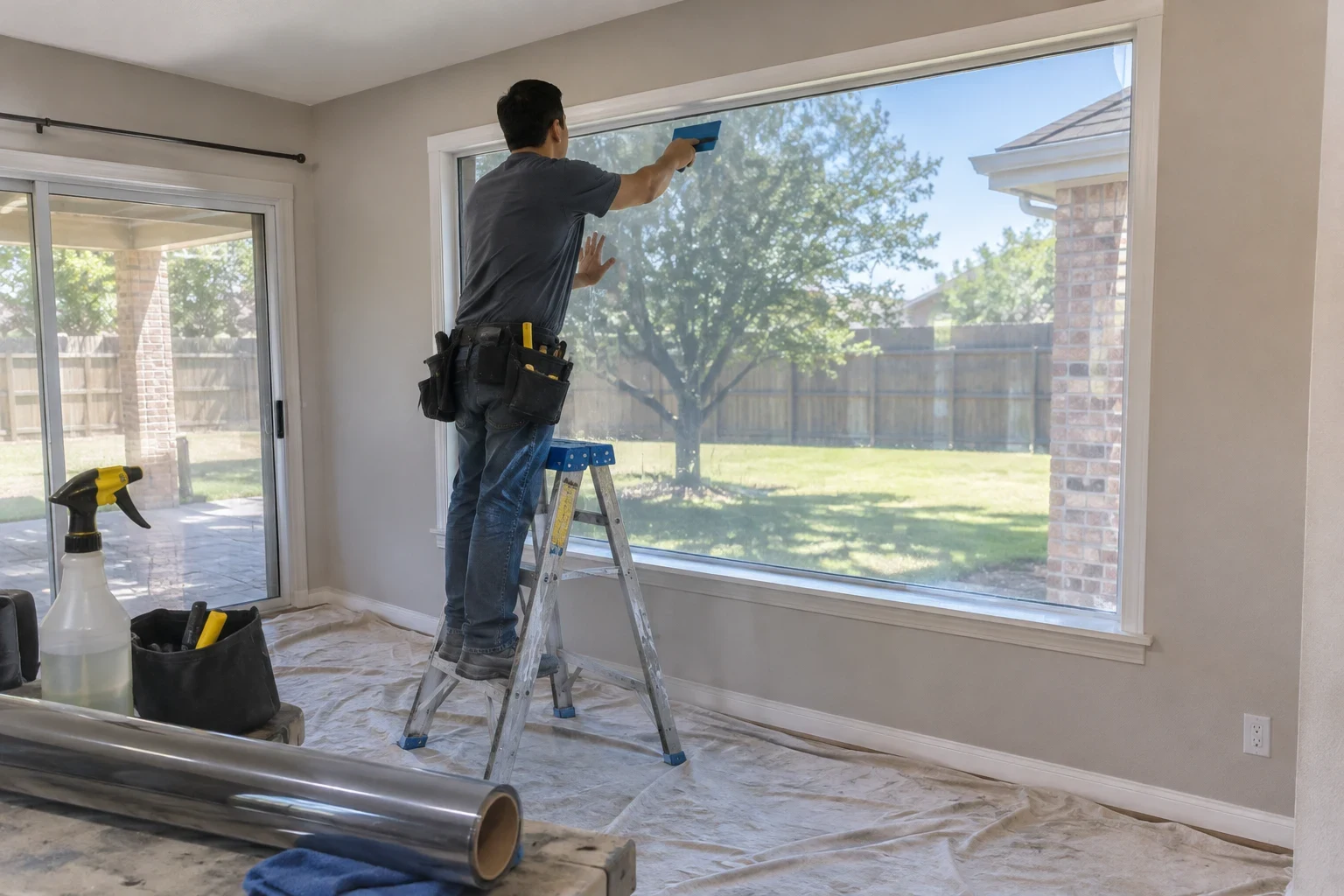
Glass is scraped and squeegeed clean, gaskets are wiped down, and film is wet-applied with a slip solution, then trimmed to a small, even gap at the edges so it does not lift against the frame.
Furniture and floor protection
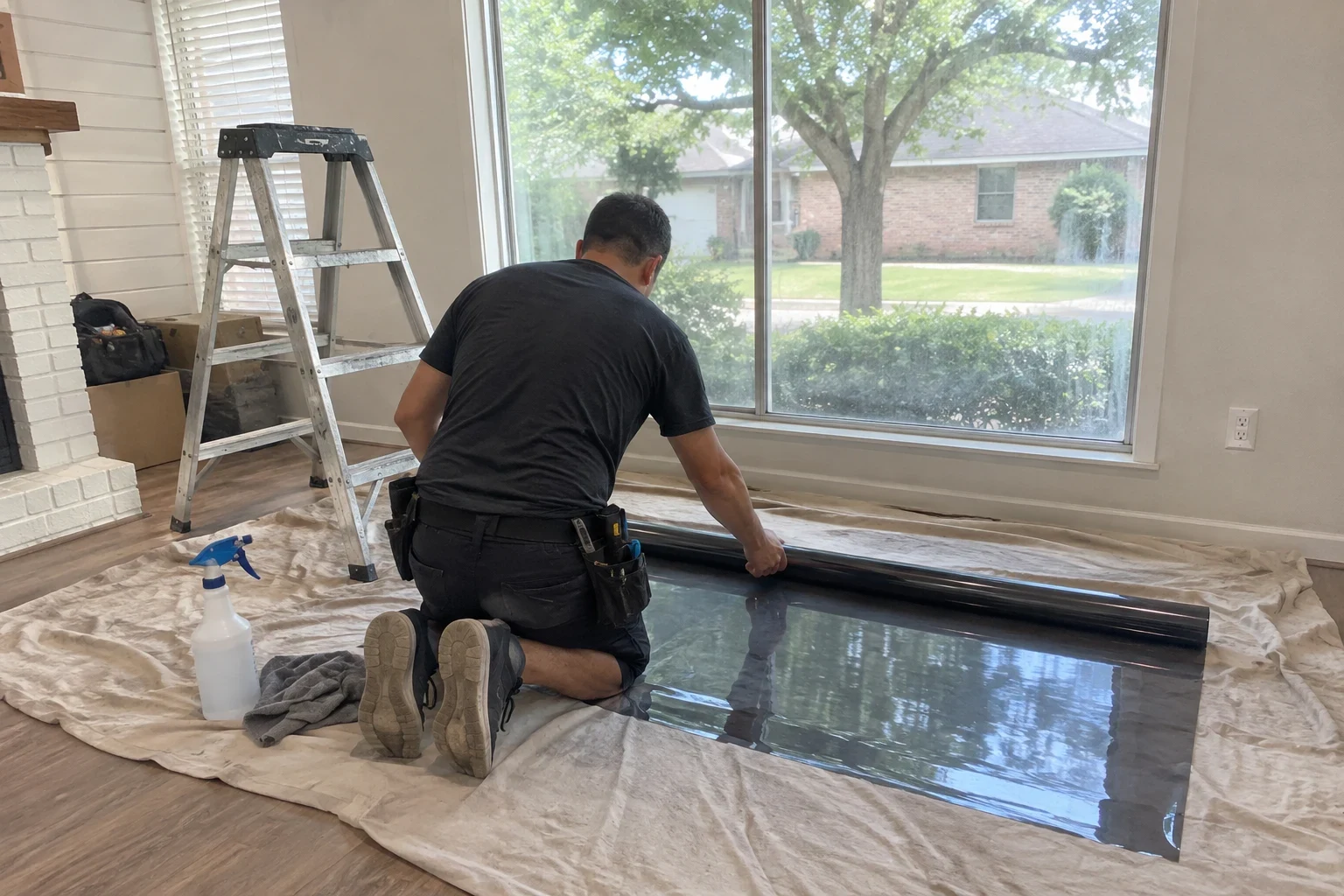
Anything sitting in front of the glass, like a dresser or a row of plants, gets shifted out of the way, and a drop cloth goes down beneath every pane. Leftover slip solution and film scraps are wiped up and bagged before we pack out.
Care instructions
You get plain guidance on curing time and which cleaners to avoid, since ammonia and abrasive pads can damage the film's scratch-resistant coat.
Signs ceramic film fits your windows
Hot spots near the glass
If a chair or bed by a west or south window feels warm on a sunny afternoon even with the AC running, infrared is getting through. Ceramic film targets exactly that.
The AC runs long into the evening
Glass that soaks up afternoon sun keeps radiating heat after sunset. Cutting solar gain at the window lowers that load during a long Gulf Coast summer.
You do not want dark windows
Some homeowners and HOAs reject a mirrored or very dark look. Ceramic film comes in light shades that read close to clear glass from the street.
Fading floors and fabrics
Ceramic films block nearly all UV, which is the main driver of fading in wood floors, rugs and upholstery. Visible light and heat add to it, so reducing those helps too.
Weak signal after a past tint
If an older metallic film seems to hurt your phone reception indoors, replacing it with a non-metal ceramic film removes that barrier.
How the work runs on install day
- 1
Consultation and measuring
We look at your windows, talk through heat, glare and appearance goals, and measure each pane. You get your quote by phone or on the spot, with each window listed.
- 2
Room prep
We clear window sills, take down blinds where needed and protect the floor. Most homes can stay fully occupied while we work room by room.
- 3
Cleaning and application
Each pane is cleaned edge to edge, the film is laid on with slip solution, and water and air are pushed out with hard-card squeegees. Edges are trimmed and sealed down.
- 4
Walkthrough and curing
We check every window with you before we leave. For the first few weeks you may notice tiny moisture blisters or a faint cloudiness while the adhesive dries out; warm, sunny days speed that up, and it disappears on its own with nothing for you to do.
What moves the price of ceramic film
Ceramic film costs more to make than a dyed film because of the nano-ceramic particles and the coating process that holds them, so it carries a higher rate per square foot. Beyond that, the number depends mostly on the square footage of glass in the job and the effort needed to get film onto it. On the consultation we list a price for every window individually, which lets you choose the ones to tackle first.
- Total glass area
- Square footage is the biggest driver. A few west-facing panes cost far less than a whole house of windows and patio doors.
- Film grade
- Ceramic lines differ in how much infrared they turn away. Higher-rejection grades cost more, and we will tell you when a mid-grade does almost as well on a particular window.
- Access and pane layout
- Second-story glass, transoms and windows split into many small divided panes take longer to cut and fit than a single large pane.
- Old film removal
- Taking off failed or bubbling film and scraping away its adhesive adds labor, more so when years of sun have baked it onto the glass.
Ceramic window film questions
Something not covered here? (281) 378-5740
Will ceramic film darken my rooms?
That part is your call. Light ceramic shades pass most of the visible light and still turn away a large share of the infrared heat. We bring samples so you can hold each shade against your own glass and judge it in your room's light.
Is ceramic film safe on dual-pane windows?
In most cases yes, when the film is matched to the glass. Absorptive film raises glass temperature, so we check the pane size, glass type and sun exposure before recommending a specific film. If a window is a poor candidate, we will tell you.
Does it interfere with phones or Wi-Fi?
No. Ceramic film contains no metal layer, so it does not block radio signals the way some metalized films can. That makes it a good choice for homes with smart devices or spotty indoor reception.
How much will it lower my energy bills?
It depends on how much sun your glass gets, which direction it faces and how efficient your AC system is. Windows facing west and south see the biggest change. We will point out which windows give the most energy savings for the money so you can start there.
Can I clean the windows normally afterward?
After the film cures, yes. Use a soft cloth or rubber squeegee with mild soapy water, and avoid ammonia cleaners, razor blades and scrub pads on the film side.
See ceramic film on your own windows
We bring samples, measure your glass and tell you which windows will make the biggest difference in heat and comfort. The consultation is free.